As online platforms continue to strengthen their detection systems, maintaining a stable and trustworthy environment has become increasingly important for multi-account operations.
Among all the factors involved, the type of proxy you use plays a critical role in how your activities are perceived by platforms.
Two of the most commonly used options are datacenter proxies and static ISP proxies. While both provide IP access, they are designed for very different use cases.
What Is a Datacenter Proxy?
A datacenter proxy is an IP address generated by cloud servers rather than assigned by a real internet service provider. Because these IPs are created in bulk and are not tied to physical households, they are widely used in scenarios that require speed, scale, and efficiency.
In practice, datacenter proxies are best suited for tasks where performance matters more than identity authenticity. For example, they are commonly used in data scraping, automation workflows, and large-scale operations where thousands of requests may be required in a short time.
However, since these IPs do not originate from real users, platforms can sometimes identify them more easily. This means they are generally not ideal for long-term account logins or sensitive operations that require a high level of trust.
What Is a Static ISP Proxy?
A static ISP proxy is a hybrid solution that combines the infrastructure of datacenter proxies with the legitimacy of residential IPs. These IP addresses are issued by real internet service providers, which allows them to appear as genuine user traffic.
At the same time, they remain stable over long periods, making them particularly suitable for account-based operations.
In real-world usage, static ISP proxies are often preferred when account trust and consistency are critical. For example, they are commonly used for managing social media accounts, running cross-border e-commerce stores, and maintaining long-term login sessions.
Compared to datacenter proxies, they offer a higher level of reliability but typically come at a higher cost.
Datacenter vs Static ISP: Which One Should You Choose?
Instead of looking at technical specifications alone, it is more helpful to compare these two proxy types based on how they are actually used.
| Scenario | Datacenter Proxy | Static ISP Proxy |
|---|---|---|
| Bulk automation / scraping | ✔ Ideal choice | ❌ Not recommended |
| Account registration (large scale) | ✔ Suitable | ⚠️ Possible but costly |
| Long-term account login | ❌ Not recommended | ✔ Best choice |
| Social media management | ⚠️ Risky | ✔ Recommended |
| Cross-border e-commerce stores | ⚠️ Limited stability | ✔ Stable and reliable |
| Ad account operations | ⚠️ Medium risk | ✔ High trust |
| Speed & cost efficiency | ✔ Strong advantage | ⚠️ Higher cost |
| Trust level / detection resistance | ⚠️ Medium | ✔ High |
Do You Always Need a Proxy?
A common question many beginners have is not just which proxy to choose, but whether they actually need one in the first place.
In Reddit discussions, experienced users often point out that proxies are not the starting point — they are a scaling tool.
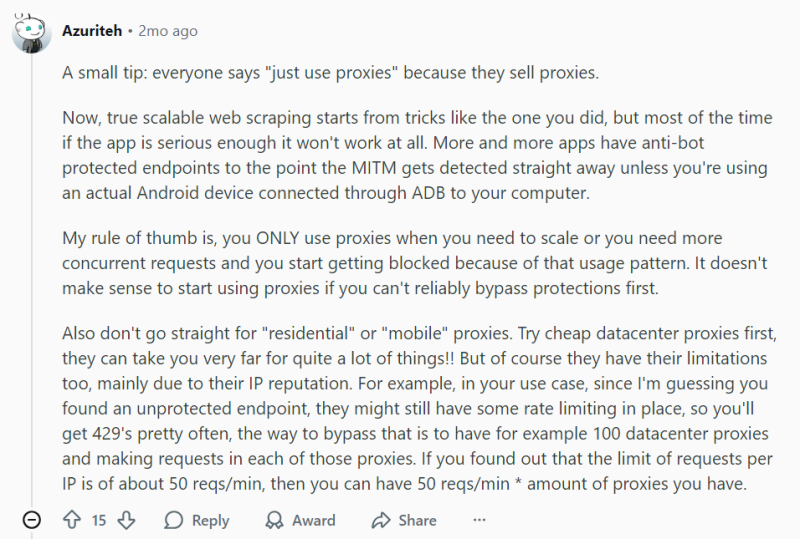
In the early stage, it is often more important to understand how a platform works, including its access patterns, APIs, and rate limits. In some cases, alternative approaches (such as using mobile APIs or optimizing request patterns) can achieve high success rates without immediately relying on proxies.
However, as operations grow, clear signals begin to appear:
- Requests start getting blocked or rate-limited
- Multiple accounts cannot run concurrently from the same IP
- Platform defenses become more sensitive to repeated activity
At this stage, proxies become necessary — not as a shortcut, but as infrastructure to support scale.
A practical approach many experienced users follow is, first, ensure your method works reliably on a small scale, and then introduce proxies when you need to increase concurrency or distribute traffic.
When starting with proxies, datacenter IPs are often the first choice due to their cost-efficiency and scalability. They can handle a large number of requests and are suitable for testing and automation.
As requirements shift toward account stability and long-term operations, higher-trust options such as static ISP proxies become more relevant.
Understanding this progression helps avoid unnecessary costs while building a more stable and efficient setup.
How to Make the Right Choice
Choosing between datacenter and static ISP proxies ultimately depends on your operational goals.
If your priority is handling large volumes of requests efficiently, datacenter proxies are often the better option due to their speed and scalability.
On the other hand, if your goal is to maintain stable accounts over time and minimize the risk of bans, static ISP proxies are the more suitable choice because of their higher trust level.
In many advanced workflows, users actually combine both types. Datacenter proxies are used for high-frequency tasks, while static ISP proxies are reserved for sensitive account operations.
Why Proxy Alone Is Not Enough
Even when using the right proxy, many users still experience account bans or restrictions.
This is because modern platforms do not rely solely on IP addresses. They also analyze browser fingerprints, device information, and behavioral patterns.
If these elements do not match your IP environment, your setup may still be flagged as suspicious.
A More Reliable Approach: Environment Consistency
To reduce detection risk effectively, your proxy should not operate in isolation. Instead, it needs to work together with your browser and device environment.
This is where an integrated solution becomes important.
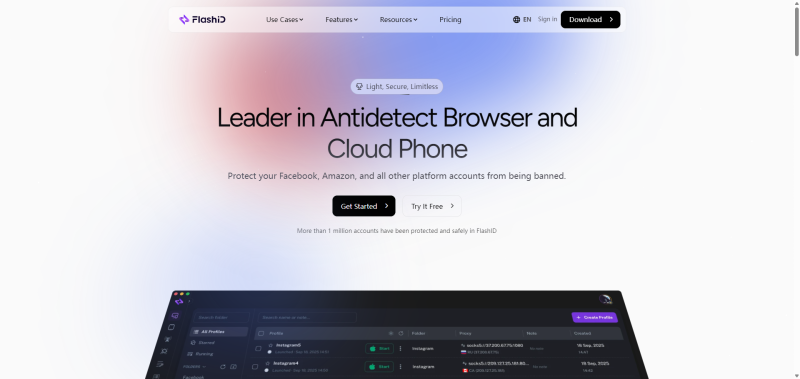
FlashID brings these components together in one platform, combining:
● Anti-detect browser (unique fingerprint for each profile)
● Built-in proxy services (Datacenter and Static ISP across 20+ countries)
● Cloud phone environments for mobile-based platforms
Each profile runs within a fully aligned environment where IP, browser fingerprint, and device signals match naturally — reducing detection risk and improving long-term stability.
Instead of managing separate tools, users can build and scale consistent environments directly within one system.
Final Thoughts
Datacenter and static ISP proxies are both valuable tools, but they serve different purposes.
Datacenter proxies excel in speed and scale, making them suitable for automation and bulk operations. Static ISP proxies, on the other hand, provide higher trust and stability, which are essential for long-term account management.
Understanding when to use each type is key to building a reliable setup.
For users who want to simplify this process, using an integrated platform like FlashID can help unify proxy, browser, and device environments — making multi-account operations more stable and easier to manage.
You May Also Like