If adding another social media platform to your plate sounds like the straw that will break the camel’s back, you’re not alone. You have to create new content, build an audience from scratch, and learn all the best practices. It feels extremely overwhelming.
Yet, this is precisely the misconception we have about Pinterest. When we think of major social media apps, we often leave Pinterest off the list, favoring TikTok, Instagram, and YouTube. But here’s the truth: Pinterest is not really a social media app. It’s a visual search engine, more akin to YouTube or Google. Understanding this fundamental shift is the key to unlocking its massive potential.
Jenna Kutcher, an expert who generates thousands of leads per month for her business using Pinterest, reveals its astonishing secret: the average “half-life” of a well-optimized Pin is over 13 months. This means a single piece of visual content you post today can continue driving traffic and creating opportunities for you a year from now, while a post on TikTok or Instagram might be “dead” within 48 hours.
This completely revolutionizes our understanding of content marketing. It’s no longer a beast you must constantly feed for a fleeting moment of exposure; it’s a goldmine where you plant a seed and it continues to blossom for years to come.
The Core Mindset Shift: From “Social” to “Search”
To harness the power of Pinterest, you must first undergo a fundamental mindset shift:
- Stop treating Pinterest like Instagram. On Instagram, you need to be personal, engage, and maintain a consistent presence. On Pinterest, no one is searching for your name (96% of searches are unbranded). You are an anonymous information provider, and your goal is to be the bridge between the user and the answer.
- Your goal is to “export,” not “retain.” Social media platforms want you to stay in the app and keep scrolling. As a search engine, however, Pinterest wants you to click the link, find the solution, and leave satisfied. Therefore, every single Pin you create should have a clear destination: your blog, your YouTube channel, your email signup page, or your product sales page.
The “1 Hour Per Week” Strategy: Amplify, Don’t Create
The most exciting part is that leveraging Pinterest’s power doesn’t require hours of your time each week. Jenna’s strategy is centered on the principle of “create content once, and amplify its value continuously.”
- Step 1: Mine Your Existing Content Goldmine. Think about it: how many blog posts have you written? How many podcast episodes have you released? How many videos have you edited? This is your goldmine. You do not need to create any new content for Pinterest.
- Step 2: Dissect and Recombine. Take one podcast episode, for example. Using Canva templates, you can quickly turn it into 10-20 different Pins. For instance:
- A simple podcast title card.
- The title with your photo.
- A pull quote from the episode.
- An infographic summarizing the key points.
- Different angles for different audiences, like “Instagram Strategies for Small Business Owners” vs. “Instagram Strategies for Course Creators.”
- Step 3: SEO Optimize and Link. When publishing each Pin, ensure your title and description include relevant keywords (just like optimizing a YouTube video title). Most importantly, set a suitable link for each Pin, guiding users where you want them to go.
- Step 4: Plan and Automate. Spend one hour each week categorizing 3-5 different pieces of content and scheduling their Pins. You can use tools like Later to automate the posting, then spend the remaining 20 minutes manually optimizing the descriptions and links for auto-uploaded Pins to maximize their effectiveness.
The brilliance of this strategy is that it activates all your existing content assets with minimal marginal cost, putting them on a “set it and forget it” autopilot for you.
From “Single Point” to “Matrix Empire”: The Ambition of Automated Operations
Once this “1-hour strategy” is proven successful, a more ambitious business blueprint emerges: Content Matrix Operations.
A savvy creator won’t just create Pins for one core piece of content; they will systematically build out a “Pinterest traffic matrix” for all of their content assets.
- Thematic Matrix: Your “Channel A” on YouTube can have a set of Pins around “AI tools.” Your “Blog B” can have another set around “healthy recipes.” Your promoted “Product C” for affiliate marketing can have its own dedicated set of Pins.
- Audience Matrix: For a single blog post, you can create different Pins targeting “beginners,” “intermediates,” and “experts,” using different titles and designs to precisely reach different user segments.
Once built, this matrix forms a comprehensive, multi-layered traffic network. Any user on Pinterest searching for keywords related to your niches could be captured by your Pin and directed to one of your various destinations. This is a truly worthy-of-being-called “digital publishing empire.”
The Invisible Shackles: The “Digital Association” Risk of Multi-Account Operations
However, building this grand empire faces a fatal and often-overlooked enemy: the multi-platform association risk and content moderation systems.
As you begin to operate this matrix, you’ll find yourself needing to manage dozens, even hundreds, of accounts—your main Pinterest account, multiple content-supporting accounts, Instagram accounts, YouTube channels, etc. Traditional management methods will trap you in a digital prison:
- Exposed Physical Environment: Are you always logging into all accounts from the same computer?
- Identical Browser Fingerprints: Does your Chrome browser, installed plugins, and screen setup look like the same person to the platform?
- Fixed IP Address: Does your home or office IP expose the geographical connection of all your accounts?
The backend algorithms of these platforms will without hesitation link this associated data together, judging you as a “matrix operator.” The result is often catastrophic: all related accounts are banned in bulk, and all previous efforts are lost. While this risk might be negligible when managing one or two accounts, it becomes a Sword of Damocles hanging over your head as your matrix scales.
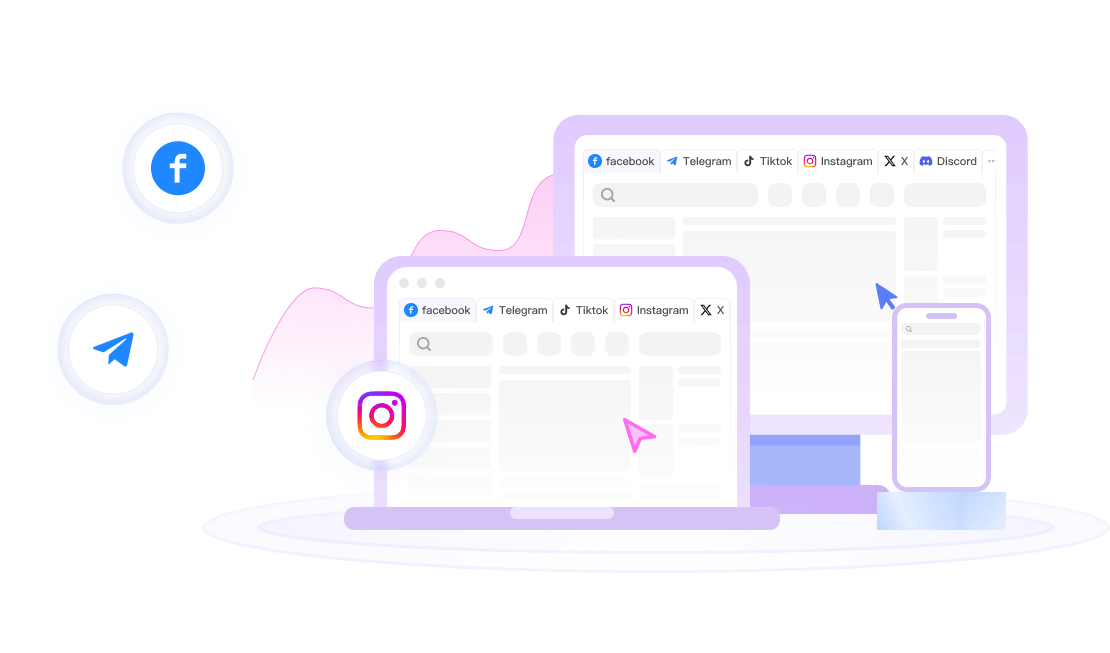
FlashID Anti-Detection Browser is precisely the “central command system” that escorts you from being an “efficient individual” to a “matrix empire builder.” It is more than just an account manager; it’s the “digital fortress” for building a secure, compliant, and efficient “digital identity matrix.”
With FlashID, you can create a completely isolated and independent digital operating environment for each role in your “content matrix.” This means:
- Absolutely Secure “Digital Identity” Isolation: Each environment has its own independent IP address, unique browser fingerprint, and cookies. From the perspective of Pinterest, Meta, or any other platform, every one of your matrix accounts appears as a real user from a different city, on a different device. This fundamentally eliminates the risk of “account association,” building a solid “moat” around your business empire.
- Scalable and Efficient Automated Management: The built-in RPA (Robotic Process Automation) feature of FlashID is your “nuclear weapon” for achieving matrix-scale operations. You can set up complex scripts to have the automated program, within its respective isolated environment, automatically complete tasks like: batch uploading Pins, scheduled posting, simulating user interactions, and even automatically adjusting keyword strategies based on data. This allows you to manage a massive account matrix with minimal mental effort, freeing up your precious brainpower for more creative content strategy and business layout.
- Seamless Mobile Coordination (FlashID Cloud Phone): When you need to manage mobile apps or perform operations that require phone verification, the FlashID Cloud Phone offers a perfect solution. You can create an independent cloud phone environment for each account that requires mobile operation, ensuring absolute identity isolation and efficient management on the mobile end as well.
When you evolve from an outstanding content creator to a strategic builder of a “digital traffic empire,” you need to ensure that each of your “territories” (accounts) is secure and autonomous. FlashID is the “digital identity master” that empowers you with this capability, allowing your ambitious visions to be realized to their fullest potential within a framework of absolute security.
Ten Frequently Asked Questions (FAQ)
Q: I’m not a designer; will making Pins in Canva be difficult for me?
A: Not at all. Canva offers a massive number of templates specifically designed for Pinterest. All you need to do is replace the text and images; the operation is very intuitive. The key is the content, not the extravagance of the design.
Q: My audience is on Instagram and TikTok. How can I be sure they are also using Pinterest to search for my content?
A: When people have a clear intent to buy or learn, they tend to use Pinterest for “research-oriented searches.” For example, looking for solutions on “how to start an online business” or buying “yoga leggings.” At this stage, your Pin has a chance to appear in the search results of potential customers.
Q: Is the Pinterest algorithm complicated? Do I need to keep learning new tricks?
A: The Pinterest algorithm is relatively stable, and its core goal is to connect users with answers. As Jenna said, this isn’t a process of “gaming the system”—it’s precisely how the platform hopes you’ll use it. As long as you follow the principle of “optimizing for search,” your strategy will be robust in the long run.
Q: How do video Pins (without audio) perform on Pinterest?
A: Video (especially B-roll footage) is effective on Pinterest. You can take those Reels that aren’t performing well on Instagram—purely display-oriented ones—and re-edit them into video Pins without audio to post on Pinterest. Graphics are still the mainstay, but video can be a great supplement.
Q: What should the posting frequency be? Is more always better?
A: It’s recommended to publish 1-2 “fresh” Pins daily (these can be new graphics on old content). Frequency isn’t the key; persistence and content optimization are. When your content library is large enough, you can increase to 5-15 Pins per day as needed, but remember to space out Pins pointing to the same content by at least a week to avoid being flagged as spam by the system.
Q: If my business is completely offline, like a local restaurant, is Pinterest still useful?
A: As long as you can visualize your service or product, it’s useful. For example, you can create Pins showcasing your signature dishes, your restaurant’s decor, close-up photos of your menu, or the reservation process, and link them to your online reservation system or review page.
Q: How exactly would I use FlashID to manage my Pinterest matrix of accounts?
A: You would create a separate FlashID environment for each of your Pinterest accounts (e.g., “Food Blog,” “Photography Tips”). During creation, assign a unique IP address and browser fingerprint to each environment. Afterwards, you can log in and manage each Pinterest account within its isolated environment just like a regular browser, without worrying about them being linked to each other.
Q: Besides posting, what other Pinterest tasks can FlashID’s RPA feature help me automate?
A: Besides posting, RPA can also help you: automatically delete old, underperforming Pins in bulk, one-click update links for all your Pins, scrape keywords from competing accounts for analysis, and automatically replicate your best-performing Pins and republish them based on backend data, greatly freeing up your management bandwidth.
Q: Where is the most effective place to send my Pins’ links?
A: Prioritize linking to platforms you own and control, like your personal blog, email landing page, or course sales page. These are the places where you 100% own user data (like email addresses) and the conversion path. Linking to your Instagram or YouTube is also fine, but the ultimate goal should still be to guide users back to your owned traffic pool.
Q: How can I tell if my Pins are working correctly?
A: Pinterest’s free native analytics tool, available with a business account, is key. Monitor “Total Impressions” (how many times your Pin was shown) and “Total Outbound Clicks” (how many people clicked your link). Low impressions mean your keyword or SEO optimization is weak. A low Click-Through Rate (CTR / Clicks divided by Impressions) means your Pin isn’t attractive enough in the search results; you need to optimize the title and image.
You May Also Like