As multi-account operations evolve from sporadic activities to long-term, systematic work, the choice of tools begins to directly affect operational efficiency and scalability. With the increase in account numbers, the complexity of environments, automated execution, and team collaboration rises significantly. Operations teams are concerned with process replicability, automation capabilities, and consistency in multi-person workflows.
Both MostLogin and FlashID offer capabilities for multi-account management, but their product design directions differ. One leans toward a flexible toolset, while the other builds a complete platform around “how to efficiently run accounts.” This difference makes FlashID a more natural choice for the stage of scaled operations.
Market Positioning: Tool-Oriented Product vs. Operations-Oriented Platform
In the multi-account management tools market, MostLogin and FlashID have distinct positioning, which is often why teams re-evaluate their tools during scaling.
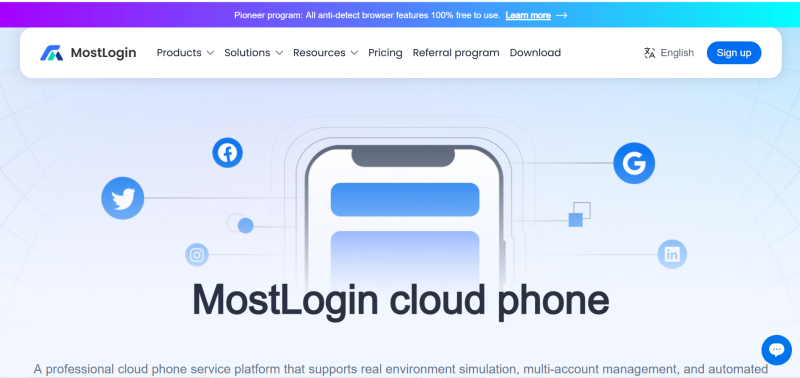
MostLogin positions itself more as an anti-detect browser + cloud phone toolset. It provides users with flexible environment configuration, proxy integration, and API/script support, suitable for teams with technical resources that want to build their own automation system. However, it requires extra effort in configuration and maintenance.
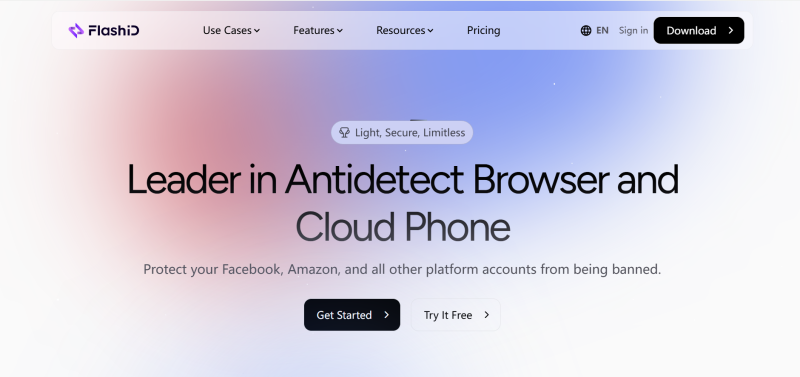
FlashID, on the other hand, clearly positions itself as a multi-account operations platform for operations teams. It doesn’t just provide individual features; it integrates browser environments, cloud phones, built-in proxies, no-code RPA, and team collaboration into a single system, designed around “how to efficiently run accounts.”
From a market perspective:
- MostLogin acts more like a foundational tool, suitable as part of a technical system.
- FlashID is closer to a turnkey solution, capable of directly supporting daily operational workflows.
When teams shift from “can it be used?” to “can it be efficiently replicated and stably executed?”, FlashID’s platform-oriented positioning aligns better with actual operational needs and can more easily support sustained business growth.
Core Advantages Comparison
| Comparison Dimension | FlashID | MostLogin |
|---|---|---|
| Built-in Proxies | Built-in proxies, unified management for browser and cloud phone environments, reducing third-party dependencies | Supports HTTP/HTTPS/SOCKS5, but users must prepare proxies themselves |
| Automation & RPA | Built-in no-code RPA, visual workflows for automation, suitable for non-technical users | Relies on APIs, scripts, and external frameworks, requiring technical resources |
| Unified Workflow (Browser + Cloud Phone) | Browser and cloud phone managed within the same system; automation and strategies can be reused across platforms | Cloud phones managed independently; requires scripts or external tools for integration |
| Team & Workspace Management | Workspace isolation, role- based permissions, operation logs support collaboration and standardized management | Basic team collaboration; limited permission controls |
| Data Privacy & Security | Account center with fine- grained permission control ensures members access only authorized browser or cloud device configurations, reducing data leakage risk | Privacy ensured through environment isolation, data encryption, WebRTC/DNS protection; permissions and access controls largely rely on team management |
| Operational Scalability | Reusable process templates; centralized environment and task management | Team must build overall system themselves |
| Technical Barrier | Low; non-technical personnel can operate | High; requires development or technical support |
After understanding these core functional differences, we can look at specific operational scenarios to help teams determine which tool better meets their needs.
Applicable Scenarios
| Scenario | FlashID Preferred | MostLogin Reference |
|---|---|---|
| Social Media Matrix Management | Manage multiple TikTok, Instagram, Facebook accounts simultaneously, unify strategies and data analytics | Can manage multiple accounts, but multi- account cross-platform collaboration and process replication require manual integration |
| Cross-Border E- commerce Account Management | Centralized management of Amazon, eBay, Shopee store accounts,stable environment, reduced risk of account bans | Supports account isolation and proxies, but process automation and scale management depend on team scripts |
| KOL/Influencer Operations Team | Multi-person collaboration,fine- grained permissions, traceable actions, unified content publishing | Collaboration possible, but limited permissions and log management |
| Advertising & Marketing Testing | Run A/B tests or landing page validation across multiple accounts; reusable workflows reduce repetitive setup | Can perform tests, but automation requires technical team configuration |
| Brand Campaigns / Promotions Execution | Quickly scale account operations, rapidly create and configure environments, ensure data isolation | Requires manual setup of environments and accounts; scalability limited |
| Customer Service / Outsourced Operations | Outsourced teams operate accounts with precise permissions, avoid data leaks, unified log management | Outsourced operation possible, but permission management and data tracking rely on team discipline |
Based on the above scenarios, it is clear how FlashID and MostLogin differ in supporting multi-account operations, especially in terms of scalability, automation, and team collaboration.
Conclusion
FlashID integrates built-in proxies, no-code RPA, unified browser and cloud phone management, fine-grained permissions, and reusable process templates into an operational platform ready for immediate deployment. Teams can rapidly deploy multi-account operations, reduce technical and maintenance overhead, and ensure data security and process control in multi-person collaboration, achieving long-term, stable, and scalable operations.
In contrast, MostLogin is more of a technical tool, suitable for teams with development capabilities or small-scale operations. For teams aiming to efficiently run multi-account operations in scalable, multi-member, multi-platform environments, FlashID is undoubtedly the safer and more efficient choice.
FAQ (Frequently Asked Questions)
1.Q: What are the main differences between FlashID and MostLogin?
A: FlashID is a full multi-account platform for operations teams, integrating browsers, cloud phones, built-in proxies, no-code RPA, and team collaboration into one system, making it more suitable for long-term, stable operations and scaling. MostLogin is more of a technical toolset, requiring manual configuration and maintenance.
2.Q: Can non-technical teams use FlashID?
A: Yes. FlashID provides visual, no-code RPA and a unified management interface, allowing non-technical personnel to quickly manage multi-account operations and automation workflows.
3.Q: How does FlashID ensure data security and permission control in multi-account operations?
A: FlashID uses an account center and fine-grained permission control to ensure team members can only access authorized accounts or devices, with traceable operations to reduce data leakage risk.
4.Q: Is FlashID suitable for cross-border e-commerce and multi-account ad campaigns?
A: Absolutely. FlashID centralizes management for Amazon, eBay, Shopee store accounts, or multi-account ad testing. Reusable process templates, stable environments, and reduced operational risks improve efficiency.
5.Q: Does FlashID support multi-person collaboration and outsourced team management?
A: Yes. FlashID provides workspace isolation, role-based permissions, and operation logs, ensuring consistency and data security in multi-person workflows, ideal for outsourced or multi-member operations.
6.Q: Does FlashID provide templates or preset workflows to quickly start multi-account operations?
A: Yes. FlashID includes built-in process templates and automation presets for common scenarios like content publishing, comment management, and ad testing, allowing teams to launch operations without building processes from scratch, saving significant time and technical effort.
You May Also Like