What Are ISP Proxies?
ISP proxies, also known as static residential proxies, are a hybrid proxy type that combine the legitimacy of residential IP addresses with the speed and stability of datacenter infrastructure. They are called ISP proxies because the IPs are assigned by Internet Service Providers (ISPs) but are hosted on datacenter servers owned by proxy providers. This gives users a residential-looking IP without the performance drawbacks of peer-to-peer residential networks.
How ISP proxies work: When you connect through an ISP proxy, your traffic appears to originate from a real home internet connection (since the IP is registered to an ISP), but the routing is handled through a datacenter server. This setup offers fast connection speeds and longer session stability compared to traditional residential proxies.
For a broader overview of proxy types, see our guide on Understanding proxy types.
ISP Proxies vs Residential Proxies: Key Differences
While both ISP and residential proxies use IPs from actual ISPs, their infrastructure and performance differ significantly.
1.Speed and reliability
ISP proxies are hosted on high-speed datacenter networks, making them faster and more consistent than residential proxies, which rely on peer devices that can slow down or go offline.
2.Anonymity and detection difficulty
Residential proxies are harder to detect because traffic originates from real devices across many subnets. ISP proxies, though using ISP IPs, often come from a limited set of datacenter subnets, making them slightly more identifiable. However, they remain much more legitimate than datacenter proxies.
3.Geotargeting capabilities
Residential proxies typically offer more granular geotargeting (city-level) due to their distributed nature. ISP proxies usually support country-level targeting and sometimes city-level, but with a narrower pool of locations.
4.Pricing comparison
ISP proxies are generally more expensive than both datacenter and residential proxies because they combine the benefits of both. Residential proxies are moderately priced, while datacenter proxies are the cheapest.
ISP Proxies vs Datacenter Proxies
Although both ISP and datacenter proxies are hosted on datacenter infrastructure, they differ significantly in IP ownership, detection risk, pricing, and suitable use cases.
1.Speed and Reliability
Both proxy types offer fast and stable connections because their traffic is routed through datacenter servers. Datacenter proxies are often slightly faster and are available in larger pools, making them suitable for high-volume tasks. ISP proxies are also highly stable and can maintain the same IP for long sessions, although their smaller IP pools may limit large-scale rotation.
2.IP Legitimacy and Detection Risk
Datacenter proxy IPs are owned by hosting companies rather than consumer Internet Service Providers. Their IP ranges are easier for websites to identify as commercial infrastructure, which can lead to more CAPTCHAs, access restrictions, or blocks.
ISP proxies use IP addresses registered to real ISPs, so their traffic appears more similar to an ordinary residential connection. This generally gives them a stronger IP reputation and makes them more suitable for websites with stricter anti-bot or account-risk systems.
3.Geotargeting Capabilities
Datacenter proxies usually provide broad country-level targeting and may offer many IPs in major server locations. However, their coverage may not accurately reflect real residential users.
ISP proxies can also support country- or city-level targeting, depending on the provider. Their location options are often more limited, but the IPs provide a more residential-looking network identity.
4.Pricing Comparison
Datacenter proxies are generally the lowest-cost proxy option because providers can create and maintain large IP pools efficiently.
ISP proxies are more expensive because ISP-issued addresses are more limited and provide stronger legitimacy. The higher cost reflects their combination of datacenter-level performance and residential-style IP reputation.
Comparison table: ISP vs Residential vs Datacenter
| Feature | ISP Proxies | Residential Proxies | Datacenter Proxies |
|---|---|---|---|
| IP source | ISP-assigned, hosted on datacenter | Real home devices (peer network) | Datacenter-owned IPs |
| Speed | Fast (datacenter-grade) | Variable (depends on peers) | Fastest |
| Anonymity | High (ISP IP, but limited subnets) | Very high (distributed) | Low (easily flagged) |
| Geotargeting | Country / some city | City / postal code | Usually country only |
| Cost | Higher | Moderate | Low |
Common Use Cases for ISP Proxies
High-volume web scraping
ISP proxies offer the speed needed for large scraping projects and the reliability to maintain long sessions without rotating IPs. They are a preferred choice for scraping e-commerce sites, job boards, and real estate listings.
SEO monitoring and rank tracking
Rank tracking tools need consistent IPs to avoid skewed results. ISP proxies provide stable, residential-looking IPs that mimic real user locations for accurate search engine ranking data.
E-commerce price and availability monitoring
Competing sellers use ISP proxies to check competitors’ pricing and stock without triggering bot detection. The combination of speed and legitimacy makes them ideal for this.
Ad verification
Advertisers use ISP proxies to verify ad placements and detect fraud from the perspective of real users. The residential appearance helps ensure ads are displayed as intended.
Multi-account management for social media and stores
Managing multiple accounts on platforms like Facebook, Instagram, or Amazon requires separate, trusted IPs. ISP proxies reduce the risk of account linking due to shared IPs.
Providers such as Bright Data, Oxylabs, and Nimble Data are known for offering ISP proxy products.
Advantages and Disadvantages of ISP Proxies
Pros: speed, stability, long sessions, residential-like appearance
ISP proxies deliver fast, stable connections suitable for automation. Their residential IPs lower detection risk, and sessions can last for days or weeks without rotation.
Cons: higher cost, low subnet diversity, limited geotargeting
The main drawbacks are price—ISP proxies cost more than residential and datacenter proxies—and limited IP diversity. Because they come from a smaller pool of datacenter subnets, they can be easier to fingerprint if a website checks routing details. Geotargeting is often restricted to country or region.
How to Use ISP Proxies for Multi-Account Management
Pairing ISP proxies with anti-detect browsers
Using ISP proxies alone is not enough for multi-account management—you also need to isolate browser fingerprints. Anti-detect browsers let you create separate profiles, each with its own proxy, cookies, and canvas fingerprint. Combining an ISP proxy with a unique browser profile helps prevent platforms from linking your accounts.
FlashID Antidetect Browser: built-in ISP proxy integration with browser fingerprint isolation
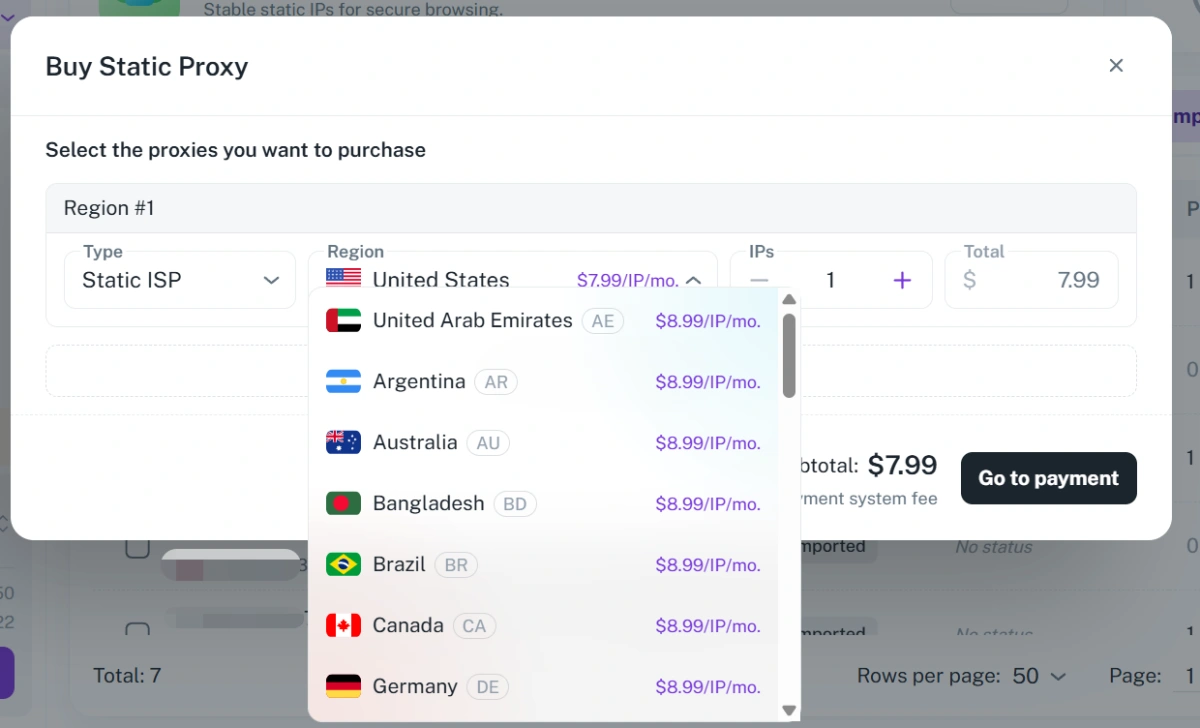
The FlashID ISP proxy feature offers a built-in proxy marketplace where you can purchase static ISP proxies in over 20 countries. These proxies are automatically assigned to browser profiles, eliminating manual configuration errors. After you set up a profile, FlashID handles the proxy binding and fingerprint spoofing so you can focus on managing accounts.
FAQ
1.What is the difference between ISP proxies and residential proxies?
ISP proxies use fixed IPs assigned by ISPs but routed through datacenter servers. Residential proxies use IPs from real home devices across a peer network. ISP proxies are faster and more stable, while residential proxies offer greater IP diversity and harder detection.
2.Are ISP proxies the same as static residential proxies?
Yes, the terms are often used interchangeably. ISP proxies are sometimes called static residential proxies because the IP is dedicated to you and does not rotate, unlike rotating residential proxies.
3.Which is better for web scraping: ISP or residential proxies?
ISP proxies are better for high-speed scraping that requires stable long sessions. Residential proxies are better for scraping sites with strict anti-bot measures that require diverse IPs from many subnets. The choice depends on your target website and volume.
4.Are ISP proxies more expensive than residential proxies?
Generally, yes. ISP proxies are priced higher because they combine the speed of datacenter proxies with the legitimacy of residential IPs. Residential proxies can be cheaper, especially rotating ones.
5.Can ISP proxies be used for social media account management?
Yes, ISP proxies are well-suited for managing multiple social media accounts. Their static nature provides consistent IPs per account, and the residential appearance reduces the risk of being flagged. Pairing them with an anti-detect browser like FlashID enhances safety by isolating browser fingerprints.
You May Also Like